
Pre-boarding, Immigration, and Connections at Aeroparque (AEP)
Image
AI image
Frequently Asked Questions
- Does Aeroparque have a transit area for connecting passengers? Not a 100% sterile zone like in other airports. In most cases, you will have to leave the secure area, collect your luggage if applicable, and go through security again (and immigration, if your next leg is international).
- How much time do I need between flights? It depends on the type of connection (see the table below), but as a general rule, never book less than 2 hours for a domestic connection and 3 hours if it involves an international leg.
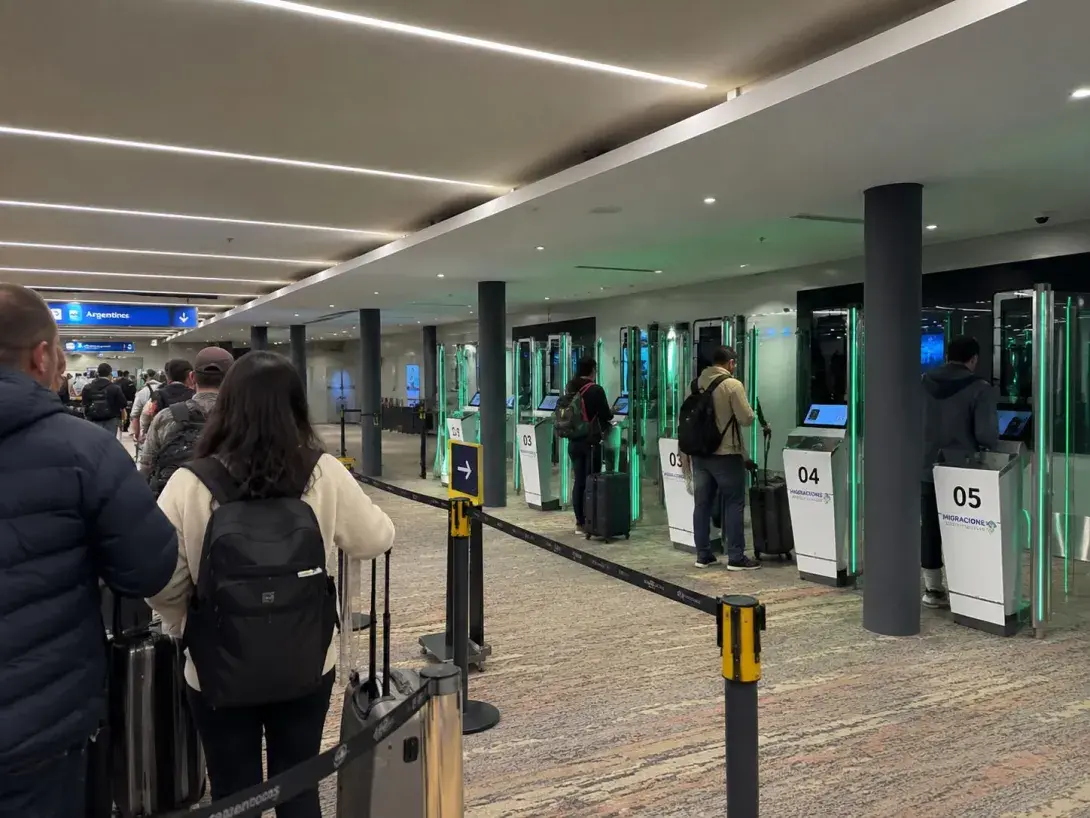
- Can I use the immigration machines to speed up the process? Yes, both for entering and leaving the country. You are eligible if you are an Argentine over 18 with a passport or chip-enabled ID, or a foreigner with a passport. Aeroparque has only 2 entry eGates and 2 exit eGates, few for the volume of passengers, but they are still usually faster than the manual line.
- Do I have to collect my luggage during the connection? It depends on whether your entire itinerary is on a single reservation. If so, the airline will likely tag your luggage to the final destination. If they are separate reservations, you will have to collect it and check it in again yourself.
- Is there free drinking water in the security circuit? It is limited. Drinking water dispensers are scarce in several sectors, according to numerous passenger reviews. Bring an empty bottle and fill it if you find a fountain before going through security.
- If Aeroparque is my final destination, do I have to go through all this process as well? If your flight is domestic, there is no immigration — you go directly to the public area. If it is international, you do go through entry immigration (with eGates available) and customs, but it is a simpler process than departure or connection.
- How does the Customs control work upon arrival? It is the "traffic light" system: you declare if you are bringing goods from abroad, and depending on that, you get a green light (you exit directly) or a red light (luggage inspection). The duty-free allowance is USD 300 per adult, plus another equal allowance if you purchased at the Free Shop.
Critical Points to Keep in Mind
- No guaranteed transit corridor. Except in specific cases of international-international connections (where some sources document yellow "Connections" signage that avoids immigration), the experience reported by most passengers is having to leave the secure area and redo the entire process. Don't take a shortcut for granted — plan as if you had to do everything from scratch.
- Few eGates for the passenger volume. The international sector has only 2 entry machines and 2 exit machines. Many travelers don't even know they exist and do the manual line unnecessarily, worsening delays for everyone.
- Immigration is the most unpredictable bottleneck. Reviews report everything from minute-long procedures to waits of over an hour, especially during peak hours (around 10 am and 7 pm) when several regional flights coincide.
- Scarce drinking water. A recurring complaint in reviews is the lack of dispensers, especially in transit and post-security sectors, forcing passengers to buy bottles at high prices.
- Aeroparque is a relatively new hub for connections. Only since late 2022 have airlines been able to sell tickets with connections from/to Aeroparque (before it was only "point-to-point"). This explains why the process is not yet as smooth as in airports with more connection history.
Pros and cons of the security and immigration system
Pros: eGates, when used, complete the procedure in less than 30 seconds; available for both entry and exit, and also for foreigners with a passport, not just Argentines; domestic security control was recently expanded with more positions; airport staff usually provide good guidance to those who ask.
Cons: only 2 eGates per direction (entry/exit) for the entire international sector; no guaranteed transit corridor for most connections; immigration and international security remain unpredictable during peak hours; scarce drinking water in the circuit.
The Standard Process: Departure Security and Immigration
This applies to any passenger boarding from Aeroparque, regardless of whether it's your original starting point or if you arrived on a connection from another airport.
Security control (pre-boarding)
What in Argentina is known as "pre-boarding" is the control where belongings and carry-on luggage are checked using X-ray scanners and metal detectors, similar to any international airport. Take laptops and liquids out of your bag in advance, and have your boarding pass and ID ready. The variable that most affects wait time is the number of operational positions at the time — the domestic sector was recently expanded with more scanners, but the international sector is still waiting for its own expansion.
Exit Immigration (international flights only)
After security, you have to go through exit immigration control. There are two paths: the traditional line with an Immigration officer, or the exit eGates. Aeroparque has only 2 exit eGates in the international sector.
User experience:
Many travelers don't know they can use the eGates and end up doing the manual line unnecessarily. They can be used by Argentines over 18 with a passport or chip-enabled ID, and also by foreigners traveling with a passport (not with an ID from another country). The system doesn't always recognize fingerprints or photos on the first attempt, but even with retries, it is usually much faster than the traditional line.
Strategy: if you meet the requirements, prioritize the eGates before joining the manual line. If you are traveling with minors under 18, you will probably have to do the traditional line anyway. If the line is not moving and the boarding deadline is approaching, approach airport or airline staff — this practice of prioritizing passengers at risk is confirmed for those coming from connections; for direct departures, there is no documented guarantee, so don't rely on it as Plan A and prioritize arriving with more time.
Arriving at Aeroparque: When It's Your Final Destination
If you are not on a connection and Aeroparque is the end of your journey, the process is much simpler than all of the above — but it varies depending on whether your flight is domestic or international.
Domestic flights
There is no immigration control. You disembark, collect your luggage if you checked a bag, and exit directly to the public arrivals area.
International flights: entry immigration
After disembarking, the first step is entry immigration control. You will find two separate lines: one for Argentines/Mercosur and another for Foreigners — stand in the one that corresponds to your document. As an alternative to both lines, there are the entry eGates: Aeroparque has 2 self-service machines for this procedure, enabled for Argentines with a passport or chip-enabled ID.
User experience:
Reports are consistent with what happens at departures: when the flow of international flights coincides in time, entry immigration lines can exceed an hour wait, with frequent complaints about insufficient staff. This phenomenon is especially pronounced during peak hours (around 10 am and 7 pm), when several regional flights — especially from Brazil and Uruguay — arrive almost simultaneously. In contrast, other passengers report procedures resolved in minutes outside those time slots.
Strategy: if you meet the requirements, use the entry eGates without hesitation. If your flight arrives near 10 am or 7 pm, allow extra margin for immigration and customs — that's when the system gets most congested.
Customs: declaration and the traffic light system
After collecting your luggage, the last step before exiting to the public area is Customs (AFIP). You must complete a declaration indicating whether you are bringing goods purchased abroad and whether they exceed the allowance. The current system is the traffic light: based on your declaration, a totem or an official assigns you a green light (you exit directly, without inspection) or a red light (your luggage goes through the scanner).
The allowance for adults is USD 300 (USD 150 for minors under 16), to which another allowance of USD 300 / USD 150 is added for purchases at the airport's own Free Shop. If you exceed that combined limit, you must pay a tariff of 50% on the excess.
Strategy: if you purchased at the Free Shop before boarding, keep the receipts — they will help you add that separate allowance when declaring. If in doubt about whether something exceeds the limit, it's safer to declare it.
Connections and Layovers: The Complicated Variant of the Same Process
Only since late 2022 have airlines been able to commercialize tickets with connections from and to Aeroparque — before that, the airport operated exclusively "point-to-point" flights. This means that the infrastructure for connections is relatively new, and it shows: the vast majority of passengers report having to completely leave the secure area between legs, regardless of whether the airport officially has transit signage for some specific cases.
Domestic → Domestic
This is the simplest scenario. Upon arrival, collect your luggage if it is not tagged to the final destination, and head directly to the check-in counter for your next flight or to security if you already have everything ready. There is no immigration in between.
Domestic → International
This is the case that generates the most doubts. Upon arriving from your domestic flight, if your luggage was not checked through to your final destination, you must collect it at the domestic arrivals carousel. Then you must move to the international sector of the airport — change wing or sector depending on how it's organized that day — and there, go through check-in/luggage drop-off, security control, and exit immigration (with its separate line and customs traffic light if applicable) again, exactly as if it were your first procedure of the day.
Strategy: allow at least 3 hours between the arrival of your domestic flight and the departure of the international one. If you have to collect and re-check luggage, add extra margin — it's the step that consumes the most time in this scenario.
International → Domestic
Upon arriving from your international flight, you go through entry immigration and customs like any passenger entering the country, collect your luggage, and from the public area you head to the domestic sector to check in for your next flight.
International → International
This is the least common case at Aeroparque, given its mostly regional/domestic profile. Some sources indicate that there is specific "Connections" signage that allows direct passage to the boarding area without going through entry immigration, in line with what is usual at other international airports. However, there is no guarantee that it is available or consistently signposted for all airlines — it's best to check with your airline before counting on this shortcut.
Strategy: if your connection is international-international, check with the airline at the time of purchasing the ticket whether the procedure includes a direct transit corridor. If you don't have that confirmation, plan as if you had to leave the secure area like in the other scenarios.
Recommended Times by Scenario
- Domestic → Domestic: minimum 1h30, ideal 2 hours.
- Domestic → International: minimum 2h30, ideal 3 hours or more, especially if you need to collect and re-check luggage.
- International → Domestic: minimum 2 hours, considering entry immigration and customs.
- International → International: minimum 2 hours, until you confirm with your airline if a direct transit corridor applies.
These times are indicative and do not replace your airline's official recommendation. If your connection is on a single reservation, the airline is responsible for re-accommodating you in case of delay; if you purchased legs separately, the risk is entirely yours — consider leaving more margin than seems necessary.
Smart Traveler's Manual
- Book everything on a single reservation if you can. It protects you against delays and facilitates luggage check-through to the final destination.
- Bring an empty water bottle. Fill it before going through security, as dispensers inside the circuit are scarce.
- Confirm the eGate requirements before traveling if you are a foreigner or a minor, so you don't waste time going to a machine you won't be able to use.
- Keep your Free Shop purchase receipts so you can add them to your Customs allowance when declaring.
- If your connection passes through both the domestic and international sectors, allow time to change sectors — it's not instantaneous, especially if you have to walk with luggage.
- If you have any doubts about your specific connection, check with your airline at the time of purchase — transit policies may vary by airline and are not always standardized across the entire airport.
